Tampilkan postingan dengan label design. Tampilkan semua postingan
Tampilkan postingan dengan label design. Tampilkan semua postingan

Count De Sakhnoffsky's 1935 illustrated cars in Esquire Magazine, and the 1936 range, though it looks terrible in comparison to the full color art


One of the great designers, and great automotive artists, I've posted everything I've come across that he's done.


Found on http://www.lov2xlr8.no/brochures/misc/esq/esp.html


Here's a treat... design art studies for Kaisers that never were produced. by Frank Hershey and Rhys Miller


The Merced, the Fairmont, the Piedmont, the Golden Gate, the Haleakala, the Menehune, the Paneole, and Del Mar
I love these old art pieces... they show how ridiculous designers are... when working on "Future" looks. Ever seen a "Future" car ever get made into production? Me neither. I don't know why they bother after all these decades of ridiculous "design studies" to keep drawing up cars they ought to realize will never be produced.
yeah, I like the art, but not the waste of time in trying to make UGLY stick around and get made into cars.
Look at the top two, there ain't no way that's going to get through the commitees and hit the assembly line.
Reminds me instantly of the other Kaiser design studies I posted 6 years ago http://justacarguy.blogspot.com/2009/07/prototype-kaisers-that-never-made-it.html the Menehune, the Pele, and the Waimea (which was fabbed up into a single custom car)
with the quirk that the Waimea actually was custom fabbed into a car http://justacarguy.blogspot.com/2014/12/the-kaiser-aluminum-creation-inspired.html


All of this reminds me that there is now a tumblr for artwork like this http://oldcarrenderings.tumblr.com/
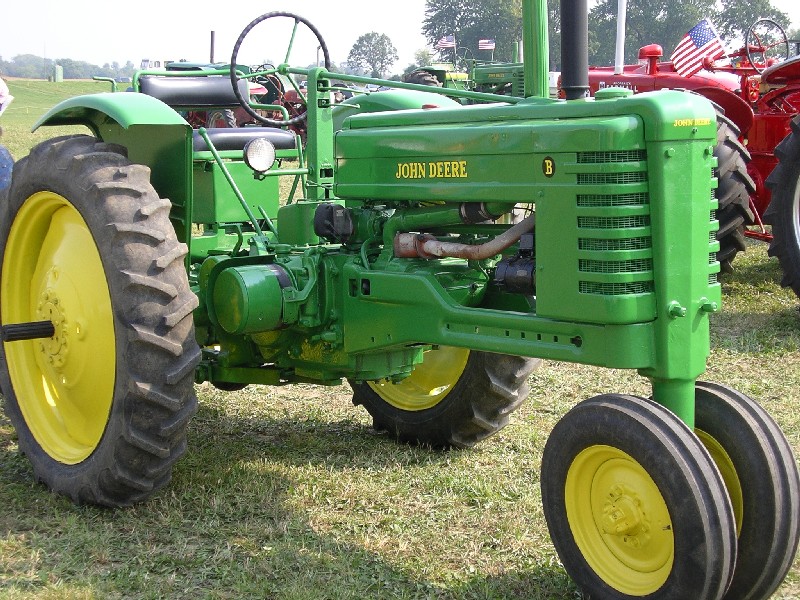
John Deere Model B and Farmall Model H... both good looking by design

In the fall of 1937, a Deere tractor engineer (named Elmer McCormick, of all things) was sent to New York to ask Dreyfuss to redesign the tractors. He worked fast: In November 1937, he unveiled a wooden mockup of a streamlined Model B.
Dreyfuss' men and the Waterloo engineers perfected the styled design that was used on John Deere tractors with only minor changes until the New Generation machines of 1960.
Dreyfuss also was responsible for design of many Deere implements, applying his "streamline should be cleanline" philosophy to the 12A combine, among others. Dreyfuss continued to do work for Deere and Co. for many years. In 1956 he recommended to company President William Hewitt that Finnish architect Eero Saarinen should design the new Deere Administrative Center at Moline, Ill.

Raymond Loewy, industrial designer, probably isn't know at all for the work he did for International Harvester Co.
In the mid-1930s, tractor builders were beginning to see the advantages of making their products more attractive by adding streamlined sheet metal. And since Fordson, John Deere and Farmall were in competition for the farmers along with Deering and McCormick, as well as a number of other tractor makers... they had to fight with more than the capabilities of such similar machines, they needed aethetics to help win over the favor of the farmers.
Oliver led the way with the streamlined row crop 70 in 1936. IHC management invited Loewy to design a new line of Farmall tractors then being developed by the company. He spent a couple of years perfecting the design. Loewy's classic styling of the new Farmalls helped make IHC a leader in row crop tractor sales until the 1950s.
Raymond Loewy also designed the new IHC logo with block letters consisting of a lower case "i" superimposed upon an upper case "H." The resulting symbol roughly resembled the front view of a (square-headed) man driving a Farmall tricycle tractor (with square tires). The logo was adopted in 1946 and became famous all over the world as the identifying symbol of International. The standardized dealership buildings with the familiar red central pylon bearing the IH logo and the dealer's name were also Loewy's work.

While looking into IHC tractors, I learned that the Cub was built with the engine offset to the left, and the driver offset to the right, because this gave the driver a better view, and this was given the name “Culti-Vision” by International. That's kinda clever.
You may have heard the names McCormick/Deering, Farmall, and International Harvester Corporation. IHC was the major player in that field during most of the last century. International Harvester Corporation had the right to use all those names.
After several years of trying to kill each other with putting dealerships in towns across the street from each other, JP Morgan managed to get the McCormick and Deering companies to merge with some smaller players into what became known as the International Harvester Corporation. In 1912 antitrust legislation forced IHC to reduce that to one dealer per town. McCormick and Deering became IHC model names. In the 1920’s Farmall joined them.
http://www.farmcollector.com/company-history/tractor-design-raymond-loewy-henry-dreyfuss.aspx
http://www.curbsideclassic.com/my-curbside-classic/my-fieldside-classic-1978-international-harvester-cub-americas-mechanical-mule/
The most beautiful streamline designs of locomotives

Streamlining the old steam locomotives was done for several reasons, as backups for the diesels that weren't trusted as much as the steam engines, and because it was cheaper to facelift old engines than by new diesels, and they felt the streamlined engines would be good for 2-10 % more weight load.
The fact that they are beautiful helps too.
In 1934 the New York Central went with the expertise of industrial designer Henry Dreyfuss, who had only worked in design since 1929.
You might also be a fan of his designs that became the Princess™ phone, the Perisphere at the 1939-40 New York World's Fair and the Strategy Rooms at the Pentagon. However, Dreyfuss is best known among 2-cylinder enthusiasts for his design of the 1939 Model A and B John Deere tractors.

above, the streamlined Art Deco styled shell of the locomotive was designed by Raymond Loewy. In 1937, Pennsylvania Railroad officials decided to build a new passenger locomotive to replace its aging K4s locomotive.
The S1 was the only locomotive ever built to use a 6-4-4-6 wheel arrangement. Also, the S1 class was a duplex locomotive, meaning that it had two pairs of cylinders, each driving two pairs of driving wheels. Unlike similar-looking articulated locomotive designs, the driven wheelbase of the S1 was rigid.
6100 was taken out of service in 1944 (after only four years of service) and scrapped in 1949.
The final construction cost for the S1 was $669,780.00

The S1 was completed January 31, 1939 and was assigned locomotive number 6100. It was the largest express passenger locomotive ever constructed, the cast steel locomotive bed plate made by General Steel Castings was the largest single-piece casting ever made for a locomotive application and was so heavy the six-wheel leading and trailing trucks were added. It so large that it could not negotiate the track clearances on most of the lines of the PRR system. In its brief service life it was restricted to the main line between Chicago, Illinois and Crestline, Ohio
To really appreciate how long this locomotive was, you must first have a frame of reference. Consider the Big Boy. The Big Boy was generally considered to be the "largest" steam locomotive ever. It was over 132 feet long. Unlike the Big Boy, the S-1 was not an articulated locomotive, yet, it was a whopping 140 feet long!

The S1 was displayed at the New York World's Fair of 1939, to reach the World's Fair, the S1 took a circuitous route over the Long Island Rail Road. Many obstacles had to be temporarily removed and other obstacles were passed at a slow crawl to reach the fairgrounds.

Here is is at the 1939 Worlds Fair with the Boy Scouts giving it a look
At the World's Fair the S1 was a dynamic display; the drive wheels operated under the locomotive's own steam power. This was done by placing the S1 on a platform that had rollers under the drive wheels. By using this type of display, visitors could see the duplex drive in use.
http://www.dieselpunks.org/profiles/blogs/sunday-streamline-14-the-big

I just posted about the Mercury, above: http://justacarguy.blogspot.com/2015/01/the-new-york-central-mercury.html

all the above found on http://www.pinterest.com/JohnLasschuit/old-steam-trains/?z=1

In 1941, Otto Kuhler streamlined a 1923 Alco Pacific locomotive for the Southern Railway for use on its Tennessean train, which (in conjunction with the Pennsylvania and Norfolk & Western) connected New York with Memphis. One of the Southern Railway’s bright green Pacific locomotives is displayed in the Smithsonian Museum, and the Tennessean locomotive combines this color scheme with the bullet-style of the B&O Royal Blue.


very faintly on the stripe down the side you can make out the words Frisco Lines


above, an example of the Union Pacific city streamliners.. full write up at http://www.dieselpunks.org/profiles/blogs/sunday-streamline-16-union


huge


all about the West Burlington Aeolus http://www.dieselpunks.org/profiles/blogs/sunday-streamline-19-west


The Crusader covered the ninety miles between Jersey City and Philadelphia in a flat 90 minutes for an average speed of 60-mph. Because the Crusader was double ended it did not require turning at terminals. The Reading simply turned the power and reversed the seats in the cars for the return trip to Philadelphia.


below: The Empire State Express info about it at http://www.dieselpunks.org/profiles/blogs/sunday-streamline-29-dreyfuss
A design by Dreyfuss

Following the success of streamline Mercury trains*, the New York Central decided to launch all-new trainsets on its Chicago line. In 1938, industrial designer Henry Dreyfuss was commissioned by the New York Central to design streamlined train sets in Art Deco style
His design was probably the most famous American passenger train of all time. The 20th Century Limited was built for style and stardom (the train conveyed the New York lifestyle) and it tailored perfectly to young executives and “new money.” So popular was the train that the Central often had to run two trains, one in each direction.


Found on http://www.lov2xlr8.no/


Langganan:
Postingan (Atom)